
Carbon Footprint Report
Your emissions baseline and path to net zero.
Contents
Agenda
- Summary — covering all the key points
- Methodology — what and how emissions were quantified
- Results — Meaningful Planet's FY25 carbon footprint
- Emission hotspot analysis — the most carbon intensive areas
- Next steps — a plan to reach net zero
- Appendices — the detail behind the calculations
Part 1
Summary
The FY25 carbon footprint
Executive summary
Overview
Meaningful Planet commissioned an external sustainability advisor to measure its first carbon footprint, covering the period 31 July 2024 to 31 July 2025 (FY25). The main reason for undertaking this assessment was to establish a baseline, which will enable emission reduction targets to be defined in pursuit of net zero by 2050. Decarbonisation efforts can also be monitored by measuring changes against the baseline.
Results
Total FY25 emissions amounted to 11.38 tonnes of carbon dioxide equivalent (tCO₂e), with purchased goods and services constituting the largest emissions hotspot (41.7% of the total). The next two most carbon-intensive areas were downstream transportation and distribution and use of sold products, representing 28.6% and 14.9% of the carbon footprint, respectively.
Methodology
The Greenhouse Gas (GHG) Protocol was used to quantify Meaningful Planet's carbon footprint. A GHG screening exercise revealed seven scope 3 emission categories to be of material relevance to the company. No scope 1 or 2 emission categories were found to be applicable; as the business scales, this is likely to change.
Next steps
Meaningful Planet should set near-term and long-term net zero targets in line with the Science Based Targets initiative (SBTi). The company should focus on tackling the emissions associated with the use of SIMs sold to customers — potential avenues include discouraging unlimited data plans, flagging heavy data users in MILO, and helping customers migrate to the more energy-efficient 5G network.
Part 2
Methodology
GHG Protocol
The backbone of emissions accounting
The Greenhouse Gas (GHG) Protocol was used to measure Meaningful Planet's emissions covering FY25 (31 July 2024 to 31 July 2025).
The GHG Protocol provides the world's most widely used emissions accounting standards for businesses. Collectively, they offer a standardised framework for companies across sectors to account and report their GHG emissions, thus facilitating global access to consistent and comparable emissions data.
The GHG Protocol Standards contain step-by-step guidance to quantify and report emissions, covering six GHGs under the Kyoto Protocol: carbon dioxide (CO₂), methane (CH₄), nitrous oxide (N₂O), hydrofluorocarbons (HFCs), perfluorocarbons (PFCs), and sulphur hexafluoride (SF₆).
Laying the foundation
Measuring what matters
Understanding the business
Meaningful Planet’s direct operations, value chain and key competitors were analysed to determine the scope 1, 2 and 3 emission categories of relevance. These would be included in the company’s FY25 carbon footprint.
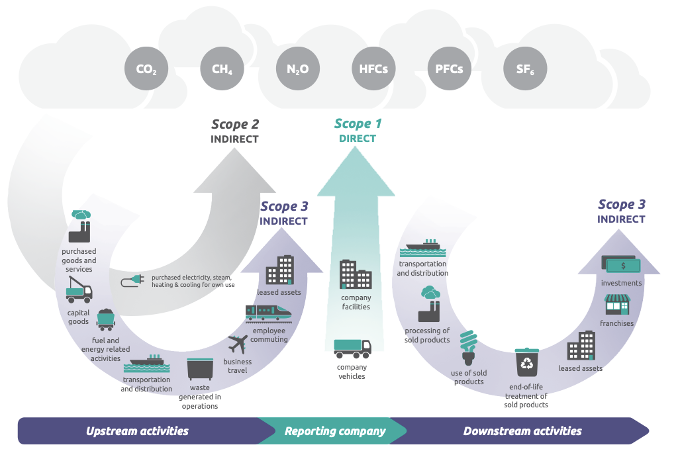
Source: GHG Protocol Corporate Value Chain (Scope 3) Accounting and Reporting Standard.
Relevant emission categories
No scope 1 or 2 emission categories were considered relevant.
Seven scope 3 emission categories were identified as material to Meaningful Planet:
- Purchased goods and services
- Upstream transportation and distribution
- Downstream transportation and distribution
- Business travel
- Employee commuting
- Use of sold products
- End-of-life treatment of sold products
Operational boundary
Emissions by scope
Emissions calculation
Approach to calculating emissions
The approach
To quantify GHG emissions, Meaningful Planet collected primary and secondary data pertaining to the seven scope 3 emission categories. This included activity data (e.g. energy consumed for remote working), financial expenditure and industry averages. In addition, appropriate emission factors were gathered to convert data into emissions; as all of the company's activities occur within the UK, emission factors were mainly sourced from the 2025 UK Government GHG Conversion Factors for Company Reporting Database.
Emissions are reported in tonnes of carbon dioxide equivalent (tCO₂e), as per the requirements of the GHG Protocol Corporate Accounting and Reporting Standard.
Emissions formula
The basic formula to calculate Meaningful Planet's emissions was as follows:
Part 3
Results
FY25 carbon footprint
Emissions breakdown
- Purchased goods & services41.7%
- Downstream transportation & distribution28.6%
- Use of sold products14.9%
- Business travel8.1%
- Upstream transportation & distribution5.1%
- Employee commuting1.6%
- End-of-life treatment of sold products0.0%
The use of sold products value (1.69 tCO₂e) captures the total expected lifetime emissions of the 129 SIMs sold during FY25 (67 eSIMs and 62 physical SIMs), applying an assumed 5-year lifespan, as required by the GHG Protocol. Separately, in-year usage across the entire active base of 973 SIMs amounted to 2.55 tCO₂e. The two measures cover different populations and are not directly comparable.
Key metrics
Beyond the absolute emission values
(tCO₂e per SIM)
(tCO₂e per customer)
(tCO₂e per £ spent)
Part 4
Emission hotspot analysis
Emission hotspot
Purchased goods and services
About
The emissions associated with goods and services purchased by Meaningful Planet was its largest emission hotspot (42% of the total). These emissions were generated during the manufacture of these products, including from the extraction and processing of raw materials.
Food and drink purchased by the company in FY25 accounted for most of the emissions (29%), followed by the purchase of Crisp (12%) and Notion (10%) software.
Notably, the emissions associated with the acquisition of physical SIM cards and eSIMs accounted for only 3.5% of the emission category.
Top five emission contributors (% of category)
Emission hotspot
Downstream transportation and distribution
About
Downstream transportation and distribution was the second largest hotspot, accounting for 29% of the carbon footprint. These emissions were produced in shipping physical SIM cards to customers from the company's registered address.
In the absence of customer addresses, an average value of 207 km was used to estimate associated emissions. With 62 physical SIMs sold in FY25, this means that the total distance travelled equated to 12,834 km.
Importantly, the transition from physical to eSIMs will help to address this emissions hotspot. In addition, assuming parcel delivery companies continue to expand the number of electric vehicles in their fleets, the transportation of physical SIM cards will become less carbon-intensive.
Key statistics
Emission hotspot
Use of sold products
About
During the reporting period, the use of sold products was Meaningful Planet's third largest emission hotspot (15% of the total). These emissions originate from the use of SIMs sold to business customers and individuals, including powering the network infrastructure and data transmission.
In line with the GHG Protocol, this category captures the total expected lifetime emissions of the 129 SIMs sold during FY25 (67 eSIMs and 62 physical SIMs). Applying the average annual emissions per SIM across the active base, over an assumed 5-year lifespan, gives 1.69 tCO₂e.
In the absence of average customer subscription data, a 5-year lifespan was applied to both physical SIMs and eSIMs. Importantly, in-year usage across the entire active base of 973 SIMs amounted to 2.55 tCO₂e.
In-year SIM usage by activity (% of 2.55 tCO₂e)
Part 5
Next steps
Monitoring decarbonisation progress
Setting net zero targets
The context
The FY25 carbon footprint will serve as Meaningful Planet's emissions baseline. This means the company can now set emission reduction targets, using the baseline to measure progress against. The targets should focus on addressing emission hotspots, especially purchased goods and services and downstream transportation and distribution.
In line with the Science Based Targets initiative (SBTi), which provides the gold standard for corporate net zero target setting, near- and long-term targets should be set to achieve net zero. Near-term targets must have a target year no more than 5 years from the base year (i.e. 2025), whereas long-term targets are to be achieved no later than 2050.
Net zero targets
The overarching net zero target could be:
- Meaningful Planet commits to achieve net zero GHG emissions across the value chain by 2050.
Possible near-term targets:
- To reduce absolute scope 3 GHG emissions 35% by 2030 from a 2025 base year.
- To reduce emissions from the use of sold products 50% by 2030 from a 2025 base year.
- To reduce emissions per SIM sold by 10% by 2028.
Possible long-term targets:
- To reduce absolute scope 3 GHG emissions 90% by 2050 from a 2025 base year.
- To reduce emissions per SIM sold 70% by 2045.
Science-based targets
The path to net zero
Adapted from the SBTi’s Corporate Net-Zero Standard.
Near-term targets
Cut emissions over the next 5 years in line with a 1.5°C pathway.
Long-term targets
Reduce emissions by at least 90% to a residual level by no later than 2050.
Neutralisation
Permanently remove and store residual emissions once the long-term target has been achieved.
Tackling emission hotspots
Focusing on what matters
To achieve net zero targets, Meaningful Planet should prioritise the decarbonisation of its three largest emission hotspots.
Purchased goods and services
Potential measures to drive emission reductions include:
- Develop a Supplier Charter to improve the emissions performance of tier 1 suppliers.
- Build carbon literacy among suppliers and help them to understand their emissions impact.
- Choose food and drink with a lower carbon profile, such as meat-free products.
Downstream transportation and distribution
Potential measures to drive emission reductions include:
- Compile customer postcodes to enhance the accuracy of the emission calculation.
- Engage with couriers to obtain specific emission factors for the shipping of physical SIM cards.
- Encourage the adoption of eSIMs among business customers and individuals.
Use of sold products
Potential measures to drive emission reductions include:
- Discourage customers from opting for unlimited data plans.
- Educate customers on the emissions impact of SIM usage.
- Support customer migration to 5G-capable devices and tariffs.
- Ensure roaming agreements prioritise more energy efficient 5G networks.
Part 6
Appendices
Appendix 1
Emissions data
| Scope | Emission category | Emission calculation method | Expenditure (GBP) | Activity type | Value | Unit | Emissions (tCO₂e) |
|---|---|---|---|---|---|---|---|
| 3 | Purchased goods and services | Spend-based | 7,278.23 | N/A | N/A | N/A | 4.74 |
| 3 | Upstream transportation & distribution | Hybrid (distance & spend) | 453.85 | Distance travelled | 913.70 | km | 0.58 |
| 3 | Downstream transportation & distribution | Average-based | N/A | Distance travelled | 12,834.00 | km | 3.26 |
| 3 | Business travel | Hybrid (distance & spend) | 2,862.31 | Distance travelled | 7,546.21 | km | 0.92 |
| 3 | Employee commuting | Consumption-based | N/A | Homeworking energy consumption | 6,015.52 | kWh | 0.18 |
| 3 | Use of sold products | Consumption-based | N/A | SIMs sold in FY25 | 129.00 | Count | 1.69 |
| Active SIMs (usage basis) | 973.00 | Count | |||||
| Calls | 152,176.30 | Minutes | |||||
| Data | 10,353.30 | GiB | |||||
| SMS | 10,911.00 | Count | |||||
| 3 | End-of-life treatment of sold products | Average-based | N/A | Landfill | 2.90 | kg | 0.00003 |
| Recycled | 0.82 | kg |
Appendix 2
Emission factors
| Scope | Emission category | Reporting year | Activity | Unit | Emissions (kgCO₂e) | Source | Comments |
|---|---|---|---|---|---|---|---|
| 3 | Business travel | 2025 | Hotel stay (UK) | Room per night | 10.4 | UK Government | |
| 3 | Business travel | 2025 | Hotel stay (Portugal) | Room per night | 19 | UK Government | |
| 3 | Business travel | 2025 | Short-haul flight, to/from UK (average passenger) | Passenger km | 0.12786 | UK Government | |
| 3 | Business travel | 2025 | Train (national rail) | Passenger km | 0.03546 | UK Government | |
| 3 | Business travel | 2025 | Taxi (regular taxi) | Passenger km | 0.14861 | UK Government | |
| 3 | Purchased goods and services | 2022 | Other food products | £ | 0.7974827772 | UK Government | |
| 3 | Purchased goods and services | 2022 | Soft drinks | £ | 0.5648235421 | UK Government | |
| 3 | Purchased goods and services | 2022 | Computer, electronic and optical products | £ | 0.5074368295 | UK Government | |
| 3 | Purchased goods and services | 2022 | Paper and paper products | £ | 0.8049973389 | UK Government | |
| 3 | Purchased goods and services | 2022 | Paper and board: paper | tonnes | 1345.0779 | UK Government | |
| 3 | Purchased goods and services | 2022 | Manufacture of physical SIM card | SIM card | 0.135 | gi-de.com | LCA commissioned by Giesecke+Devrient (G+D) and conducted by Fraunhofer IZM in 2022 showed a full lifecycle total of 229 gCO₂e for a physical SIM card over a three-year period. 59% of emissions occurred during the production phase, equating to 135 gCO₂e per SIM card. |
| 3 | Purchased goods and services | 2022 | Manufacture of eSIM | SIM card | 0.00246 | gi-de.com | LCA commissioned by Giesecke+Devrient (G+D) and conducted by Fraunhofer IZM in 2022 showed a full lifecycle total for the eSIM. |
| 3 | Upstream T&D | 2025 | Van, Average (up to 3.5 tonnes) | km | 0.2543 | UK Government | |
| 3 | Upstream T&D | 2025 | Freight train | tonne per km | 0.02779 | UK Government | |
| 3 | Upstream T&D | 2025 | RoRo-Ferry | tonne per km | 0.05158 | UK Government | |
| 3 | End-of-life treatment of sold products | 2025 | Landfill (WEEE – small) | tonnes | 8.98311 | UK Government | |
| 3 | End-of-life treatment of sold products | 2025 | Recycled, open-loop (WEEE – small) | tonnes | 4.68568 | UK Government | |
| 3 | Employee commuting (homeworking) | 2025 | Electricity consumption – National Grid T&D losses | kWh | 0.01853 | UK Government | |
| 3 | Employee commuting (homeworking) | 2025 | Biomethane consumption – Ecotricity supply | kWh | 0.0355 | Ecotricity | 35.5 kgCO₂e/MWh reported as lifecycle emissions from biomethane production in their ‘Green Gas Mills’. |
Appendix 3
Assumptions and key considerations
| Scope | Emission category | Assumptions | Omissions | Key considerations |
|---|---|---|---|---|
| 3 | Purchased goods and services | Physical SIM cards included in the calculation despite being purchased in FY23/24, to ensure completeness and transparency. | ||
| All eSIMs purchased by Meaningful Planet included in the calculation, for completeness and transparency. | ||||
| Physical SIM card weighs 0.3g. | ||||
| Seed paper weighs 3g. | ||||
| Envelope weighs 8g. | ||||
| All expenditure made by Meaningful Planet in FY25 treated as OpEx (no CapEx). | ||||
| 3 | Upstream transportation and distribution | Shipping of physical SIM cards consisted of: (1) Transatel to Calais – van; (2) Calais to Dover – Eurotunnel; (3) Dover to Wisbech – van; (4) Wisbech to Portsmouth – van; (5) Portsmouth to Fishbourne – ferry; (6) Fishbourne to MP’s registered address – van. | ||
| Average van factor applied as the shipment was assumed to travel as part of a consolidated courier load. | ||||
| Average van (unknown fuel) emission factor applied, as the courier vehicle’s fuel type is unknown. | ||||
| Eurotunnel assumed over the ferry, as it is faster. | ||||
| 3 | Downstream transportation and distribution | Average van factor has been applied as shipment was assumed to travel as part of a consolidated courier load. | Average distance travelled (207 km) per SIM used. | |
| Average van (unknown fuel) emission factor applied, as the fuel type of courier vehicle is unknown. | ||||
| 3 | Business travel | |||
| 3 | Employee commuting | The average working day for an employee at Meaningful Planet consists of 8 hours. | Applied the same electricity and gas emission factors for Ecotricity supply to Octopus supply, as similar renewable sources are used. | |
| Richard West is on a green tariff for energy supply (unknown provider). | ||||
| 3 | Use of sold products | In line with the GHG Protocol, the category covers the total expected lifetime emissions of the 129 SIMs sold during FY25 (67 eSIMs and 62 physical SIMs), rather than the in-year usage of the whole active base. | N/A | In-year usage across all 973 active SIMs amounted to 2.55 tCO₂e. This is the figure to be offset annually, and covers a different population to the lifetime figure; the two are not directly comparable. |
| An average annual emission per SIM was derived from total in-year usage divided by the 973 active SIMs, then applied to the SIMs sold in FY25. | ||||
| A 5-year lifespan has been applied to both physical SIMs and eSIMs. eSIMs do not physically degrade, but in the absence of average customer subscription data the physical SIM lifespan has been used as a proxy. | ||||
| 3 | End-of-life treatment of sold products | Based on the global treatment of e-waste (around 22% recycled), the same split was assumed for physical SIM cards once disposed of by customers, due to a lack of data specific to SIM card waste. |
Contact
Get in touch
For any questions about this report, please contact:
James Beiny